Friday, June 17, 2022

UCP leadership race gets crowded

Anyone else?  Following a slight majority leadership vote and the subsequent Alberta Premier Jason Kenney "stepping down", initially, we thought there'd be maybe a few contenders.


Former Wildrose leaders Danielle Smith and Brian Jean and probably an existing cabinet minister seemed to be the front-runners.  


Travis Toews is that cabinet minister who will likely have the backing of a good chunk of the existing executive.  But so might...


Rebecca Schulz - MLA and now former children's minister who seems to toe the party line.


Then there is… who?


Rajan Sawhney - MLA and now former transportation minister and previously the social services minster who saw claw backs on AISH but now says they should be restored with provinces finances in better shape.  Nice try.


Leela Aheer -- I've heard of her name but not sure... looking up... oh yes, she's a backbench MLA and has openly criticized Kenney.  She seems to be more on the progressive side.


Todd Loewen -- I think he was booted out of the UCP caucus for, you guessed it, criticizing Kenney.  He seems to be on the right flank.


Bill Rock -- Haven't heard of his name before but now see that he's mayor of Amisk.


But now we have Michelle Rempel Garner who is seriously contemplating a switch. This is an odd move considering she’s been backing Jean Charest in the CPC leadership race. Does she not see if he wins she’d be elevated or does she see he won’t win over Pierre Polievre?  


The UCP has a $150,000 fee to enter.  Federally, it’s twice that I think.  


Of the MLAs, Toews has the most name recognition but campaigns matter.  As this is a ranked ballot, having similar candidates is beneficial to then rally subsequent round counts.


That's how Erin O'Toole won.  There were more votes to be found in subsequent rounds from the other candidates like Leslyn Lewis on the social conservative side.  But it eventually bit him in the ass as he tried to move the party to the middle.  Peter MacKay didn't have as many.  Where Jean Charest has an advantage here though is there are a couple other progressive-minded candidates where he can get other ranked choices from.


I personally don’t like these ranked ballots. Let’s go back to delegates and conventions! 


So converting the history to now, the ideological streams appear to line up on the choices.  While smaller campaigns aren’t obligated to be loyal to the bigger fish, and there’s no time for a run off vote, candidates need to widen their message a bit to envelope the other campaigns while creating a wedge between the other bigger fish.  


It’s a fine balance that’s a different style of campaigning than a usual election where you simply need a plurality of votes.  Here you need 2nd, 3rd, 4th, 5th round voted all in the same process!  


How would I rank in a vote?   

I honestly have no idea.  I’m not a member anymore.  


Thursday, August 27, 2020

O'Toole learned, MacKay didn't

 #cdnpoli #cpcldr

Erin O'Toole, the newly elected Conservative Party leader, learned from his last run that he needed to play more hardball.  In that previous race not long ago, O'Toole came across as a more progressive conservative and didn't get the support or attention compared initially to Kevin O'Leary, Maxime Bernier, or Andrew Scheer.  

What's perplexing is Peter MacKay used to play hardball. But that was when he won the Progressive Conservative leadership in 2003 when he signed a promise on a napkin to candidate David Orchard that he wouldn't merge the PCs with the newly-led Stephen Harper's Canadian Alliance.

PC leadership 2003

You'll recall that race 17 years ago, was one of the last convention-style leadership elections with delegates. The results:

1st ballot:  MacKay 41.1%, Orchard 24.3%, Jim Prentice 18.2%, Scott Brison 16.4%, Craig Chandler 0% (endorsed Prentice)

2nd ballot:  MacKay 39.7%, Orchard 24.1%, Jim Prentice 18.2%, Scott Brison 18.0%

3rd ballot:  MacKay 45.0%, Orchard 24.6%, Jim Prentice 30.4%, Scott Brison (endorsed Prentice)

4th ballot:  MacKay 64.8%, Orchard (endorsed MacKay), Jim Prentice 35.2%

The result was later that year, the two conservative parties merged with the Canadian Alliance members voting by mail with 96% in favour, and for the PCs, a quick riding by riding phone-in blitz.  A leadership race ensued, MacKay sat it out, and Harper won over MacKay's future girlfriend and then Liberal floor-crosser, Belinda Stronach.  Harper would go on to lose to Paul Martin's Liberals, albeit a minority government.  But then because of Adscam prominent in voters minds and a poor Liberal campaign run by strategists David Herle and Scott Reid, Harper won a couple minority governments, one against Stephane Dion.  He'd eventually win his "strong stable majority Conservative government" against Michael Ignatieff with a strong NDP showing as its first time as official opposition by the late great Jack Layton. About a decade of Harper as Prime Minister, until Justin Trudeau came along.

CPC 2020

For MacKay in 2020, there appeared to be an overconfidence in his campaign, almost passive in thinking it was an anointment, and shows that having the majority of caucus support doesn't always guarantee a win.  Stephen Harper never campaigned like that.

From the start this leadership race, pandemic aside, nearly out of the gate, when asked whether he'd march in pride parades, Erin O'Toole's answer was basically "if first-responders are allowed, then yes" where MacKay simply said yes.  That set the tone early-on and drew lines in the sand and sent a signal to the other candidate supporters that he's listening.

Did the pandemic affect Peter MacKay's chance of winning?  I don't think so. The candidates were already in full-swing and members had an idea who they're first choice was. It was the second and third choices that were really in play after that. Or were they?

On that, leadership candidate Dr. Leslyn Lewis made a strong impact on 2nd and 3rd ballot choices as there was more time for the membership to get to know her and what she stood for.  She ran a very reputable campaign that garnered much respect and attention. She actually had the most votes on the 2nd ballot but not points--meaning she didn't have enough broad national support (more on that).  She plans to run for MP again.  As a way to draw attention to a local candidacy, running for leadership certainly helps.

Social Conservatism

With O'Toole winning, people I know who are more liberal in their views said they were disappointed in the results as they would have voted for Peter MacKay's Conservatives.  They're tired of Trudeau's public and private ethics violations.  They see O'Toole's win as a unification, albeit a party take-over by social conservatives.  

Perhaps.  If you look at O'Toole's voting record in the House of Commons and what he's said, he's really not a true social conservative and the Campaign Life Coalition certainly does not support him.  But his campaign made it seem to the Sloan and Lewis social conservatives that there was no room for them in a Peter MacKay-led Conservative Party, but there was in his.  And that's all it really seemed to take.

Canadian conservatives are an enigma in politics. I've been following it intensely for 30 years and have been at some of its historical moments.  Some conservatives can't stand it when Liberals win, but some accept it.  But when they do win, it's only when they are united, despite the vast divisions socially, and that takes having an ear to both sides.

Wexit

Beyond the social ideology, there is an eminent threat from the Wexit Western Canada and Alberta separatists led by former Harper cabinet minister and government house leader, Jay Hill.  Will O'Toole be able to appease them or will they remain a small faction, as is usual with blurts of western separatism?  

I think if he doesn't fan the flames and ensures Wexit doesn't grow, they won't split votes with the Conservatives, there's nothing to worry about.  Peter MacKay's first ballot third place showing in Alberta may indicate that if he won, Wexit would have more teeth.  With Erin O'Toole winning, we haven't heard anything in the past few days from Wexit.

Quebec

Then there's Quebec--which, like Andrew Scheer did in pandering to the dairy industry, those ridings put O'Toole over the top. Conservative membership continues to wane in Quebec and membership numbers have dropped--likely because there wasn't a candidate from there and the four candidates in the race did not have their French-speaking up to snuff.   Further, with many ridings having fewer than 100 members, giving a single vote far more sway there than in every populated Alberta riding.  MacKay had the backing of most of the Quebec caucus, yet they just didn't deliver for him.

Uniting conservatives of different shades under a big blue tent is never an easy task.  You can't shun or not listen to Western alienation. You can't shun or not listen to social conservatives.  You can't shun or not listen to progressives.

Stephen Harper knew how to do just that and why he was so successful at the party-level, and nationally as well.  But he had unifying conservative policies that all stripes could get behind. 

It seems Erin O'Toole learned.  We'll see if this translates nationally.


Wednesday, November 06, 2019

Scheer: "Re-double our efforts"

 #cdnpoli

“More Canadians wanted us to win this election than any other party,” Scheer said. The next day he framed the loss as the “first step” towards ousting Trudeau. “We’re going to re-double our efforts for next time,” he said.  (Source.)

This brings to mind a very similar quote spoken in a very popular movie.


And we all know what happened to the Death Star Version 2 anyway, don't we?

Monday, October 21, 2019

Canadian 2020 election prediction and other predictions

Election Predictions! Get your Election Predictions here! My Tory majority prediction from last week is out the window. I’m seeing it’s almost like 1972 when another Trudeau led a minority coalition. History repeats itself.
142 Conservatives
125 Liberals
35 NDP
33 Bloc
2 Green
1 Independent
0 People’s Party
As pollster Nik Nanos said, “Now it’s about the ground game and delivering votes.” This is where I believe the Conservatives have an advantage. With the advance polls showing a 25% increase, the Conservative base being larger, more motivated, and unwavering, the campaign has been relentless in getting out the vote in the advance polls and will be on Oct 21. But it won’t be enough in Ontario to flip the 905.
The aftermath will see many wanting Trudeau, Singh, and May try to form a coalition government of Liberals, NDP, and Greens.
Trudeau being the self-serving guy he is will try and make it work. So they give it a shot and ask the GG to form government.
After many recent provincial elections, and this one being very divisive, Canadians will reject the idea of having another election. The coalition government lives on.
Tories are careful not to be seen “in bed” with the Bloc separatists to defeat the government. But oh man, they are angrier than ever.
The country couldn’t be more divided. Alberta separation sentiment becomes more of the talk and while a federal Alberta Block Party becomes a thing, Premier Kenney gets even louder about provincial rights. For the Bloc, same thing.
After about two years, the national debate on provincial autonomy becomes the reason why the Tories and Bloc decide to defeat the coalition government.
All the parties have the same leaders. Liberals call the Tories bluff and Canadians tired of the stunt, plus an unstable recession economy, vote for stability with Trudeau in a majority government again.
Just like his father did in 1974. Like I said, history repeats itself.
Andrew Scheer steps down as Tory leader. Tories have a leadership race in 2022 and Peter MacKay wins it. Over whom, I’m not sure.
Canadians tired of ten years of Trudeau at the helm, vote for change in 2025 and lean to MacKay’s more moderate Conservative party with a majority. This is where it differs from history because Tory Joe Clark won the election with a minority in 1979. This is because comparatively, Peter is well known compared to Joe at the time. MacKay wins two terms.
There you have it folks.
Oh, and Kenney wins Alberta again in 2023 and 2027. Ford does not win Ontario in 2022 and for the federal Tories, this is a good thing.
Meanwhile in the USA, Trump wins in 2020. With the Democrats not finding a new candidate, Barack Obama is begged to return in 2024.
In Russia in 2024, after two terms of Putin, Medvedev wins the presidency again with Putin as his Prime Minister again. In 2030, Putin wins again and rules until 2042 at the age of 89.
To keep Putin in check until then, German Chancellor Angela Merkel continues until the age of 88.
The UK has four more prime ministers and still hasn’t Brexited the EU.
Pope Francis remains in perfect health until he steps down in 2029 at 92 years.
Some of these predictions might very well come true (see: Putin).
Now remember to always vote when you can. Do it early and do it often!

Friday, October 04, 2019

Trudeau mentioning Doug Ford as much as Scheer is working

 #cdnpoli #cdnelxn

Like I said in my last post, Ontario is the real battleground and why Trudeau mentions Ford just as much as Scheer, and is still even mentioning Harper.

The current aggregation of polls in Ontario shows that although the Liberals are up by about 7 points, seat-wise it translates as:

75 (+/- 31) Liberals
30 (+/- 28) Conservatives

So the absolute worst the Liberals can do in Ontario is 44 seats and Conservatives best is 58 which makes other parts of the country in play.  Half of that is 60 for Liberals and 44 for Conservatives.

Note that before the campaign the seat projections were:
63 Liberals
49 Conservatives

This is a change of:
+12 seats Liberals
 -19 seats Conservatives

That's a +27 seat swing in Ontario in favour of Trudeau.  SEATS.  This means that the Conservative campaign in Ontario has massively failed and why Trudeau will win. Full stop. Nothing else really matters, does it?

When the federal party doesn't want to mention the provincial leader, the provincial party infrastructure support collapses.  I mean, the Ontario PCs aren't exactly united after that last leadership debacle either and are probably not too motivated to support boring Saskatchewan Scheer.

It's also why the Liberals are targeting Scheer's credibility now as well and why he's hit a ceiling. 

From our cheap seats, it appears the best the Conservatives can really do is make Scheer seem bland and not scary and equally attack Trudeau on his proven lack of credibility and hope that those who were leaning toward him just don't vote. 

But that's a stretch against decades of history.

Has there really been a polarizing issue dividing Canadians other than leader credibility?  Is it the environment?  Liberals are banking on that one in order to gain a couple points with those leaning toward Green or NDP, but the Greens in Ontario are insignificant where the NDP play in Northern Ontario quite well and there are several swing ridings there.

With Thanksgiving weekend approaching and family talks at the dinner tables, policy won't be the discussion, but how fake Trudeau is and how unscary Scheer is which boils down to the cliche "The devil we know versus the one we don't" or "The blackface devil we know versus the whiteface quiet scary one."

And in Ontario, it appears Ford has also become a known devil and history shows the federal Conservatives will get the fallout from that.


Thursday, September 26, 2019

Why an Ontario political party should not help federally and vice versa

The article below shows how Ontarians provincial election results continue to massively affect the next federal election.

https://nationalpost.com/news/politics/election-2019/exclusive-poll-reveals-doug-ford-factor-a-big-problem-for-scheers-conservatives-in-ontario

Look at the history, particularly post-WWII.

Provincially, the majority of Ontarians will vote in the next election for the other party that is not in power federally about 86% of the time.

Federally, the majority of Ontarians will vote for the other party that is not in power provincially about 65% of the time, which is what appears will happen on October 21, 2019 federally as the article above certainly indicates that the majority of Ontarians will vote for the federal Liberals over the provincial PCs.

So I continue to wonder why a federal party would help their provincial cousins in Ontario knowing they are going against history a large majority of the time and vice versa.

If anything, they should remain quiet, stay far away, and hope they lose.


Here’s the list..

Ontario Canada Ontarians balance provincially? Ontarians balance federally?
1940 Liberal Liberal
1941 Liberal Liberal
1942 Liberal Liberal
1943 PC Liberal Y
1944 PC Liberal
1945 PC Liberal Y Y
1946 PC Liberal
1947 PC Liberal
1948 PC Liberal Y
1949 PC Liberal Y
1950 PC Liberal
1951 PC Liberal Y
1952 PC Liberal
1953 PC Liberal Y
1954 PC Liberal
1955 PC Liberal Y
1956 PC Liberal
1957 PC PC N
1958 PC PC N
1959 PC PC N
1960 PC PC
1961 PC PC
1962 PC PC N
1963 PC Liberal Y Y
1964 PC Liberal
1965 PC Liberal Y
1966 PC Liberal
1967 PC Liberal Y
1968 PC Liberal Y
1969 PC Liberal
1970 PC Liberal
1971 PC Liberal Y
1972 PC Liberal Y
1973 PC Liberal
1974 PC Liberal Y
1975 PC Liberal Y
1976 PC Liberal
1977 PC Liberal Y
1978 PC Liberal
1979 PC PC N
1980 PC Liberal Y
1981 PC Liberal Y
1982 PC Liberal
1983 PC Liberal
1984 PC PC N
1985 PC PC N
1986 PC PC
1987 Liberal PC Y
1988 Liberal PC Y
1989 Liberal PC
1990 NDP PC Y
1991 NDP PC
1992 NDP PC
1993 NDP Liberal N
1994 NDP Liberal
1995 PC Liberal Y
1996 PC Liberal
1997 PC Liberal Y
1998 PC Liberal
1999 PC Liberal Y
2000 PC Liberal Y
2001 PC Liberal
2002 PC Liberal
2003 Liberal Liberal N
2004 Liberal Liberal N
2005 Liberal Liberal
2006 Liberal Conservative Y
2007 Liberal Conservative Y
2008 Liberal Conservative Y
2009 Liberal Conservative
2010 Liberal Conservative
2011 Liberal Conservative Y Y
2012 Liberal Conservative
2013 Liberal Conservative
2014 Liberal Conservative Y
2015 Liberal Liberal N
2016 Liberal Liberal
2017 Liberal Liberal
2018 PC Liberal Y
2019 PC ?
19 15
22 23
0.863636364 0.652173913


Monday, May 07, 2018

Rah Rah Ras Putin continues his grip

A quick timeline of Vladimir Putin's reign over Russia:

1999 - On the surprise resignation of Boris Yeltsin, Putin became acting Russian President

2000 - Elected as President for a 4 year term

2004 - Elected as President for a 4 year term

2008 - Putin's puppet Dimitry Medvedev elected as President for 4 year term.  Medvedev appoints Putin as Prime Minister.  Soon, the 4 year term limit is increased to 6 years.

2012 - Putin elected as President for 6 year term.

2014 - Russia hosts the Winter Olympics in Sochi.  Russia invades and annexes Crimea from Ukraine and to this day, continues a microwar in Eastern Ukraine.

2018 - At 65 years of age, Putin is elected as President for 6 year term.  He'll be 71 in 2024.

Let me guess.  In 2024, Medvedev will be President and Putin will be appointed Prime Minister for 6 years.

Without a doubt, Vladimir Putin is and will be the most successful politician of my generation having served as a leader over a country that "elects" for 30 years.

Meanwhile over 1600 protesters have been arrested.

Tuesday, November 14, 2017

Alberta Party taken over by PCs

 #abpoli

Greg Clark
METRO CALGARY FILE PHOTO

Alberta Party leader and nice guy Greg Clark stepped down on November 10, a Friday before a long-weekend, which is a subtle method to subvert any media traction.

The announcement then fell only to the fanfare of politicos and former PCers (emphasis on the "P") from the Redford days, who have obviously been pining for room at the table since Kenney won the leadership of the UCP. 

I know folks who didn't even know there was an Alberta Party.  "So there's an Alberta Party. Who knew?"

And that right there is why Mr. Clark was shown the door.  If you're going up against the KenneyMachine, playing nice won't get you as far as you need to go.  It is why the Alberta Party could not get momentum or build--certainly in comparison it took for the Wildrose.

Politics, in case you haven't noticed, and as I've mentioned in my previous post, has become the game of divide and conquer.  There is no nice-guy mushy middle where ideas are debated, compromises made, and an agreeable solution is churned out and popped to the surface.  It's become two sides.  So for the Alberta Party which like the Alberta Liberal Party prided itself on middleware, balance, and "working together", found itself like a turtle on its back waiting to be picked up, kissed, and transformed into a komodo dragon (or whatever) as a reasonable home for more aggressive progressives (I'm totally coining that term).

And so now we have a slew of potential leadership candidate names that remind me of a cast of characters from a certain cabinet.

Thomas Lukaszuk
Stephen Mandel
Dr. Gerry Preddy

The Twittertone of the Alberta Party has upped its game too.  As I said, it's how politics has changed into 140 character sound bites (280 for the lucky few).  Twitter is the level playing field and if you can gain attention with loud sounding bites and attacks, there's bound to be folks who'll support you.

So how can the Alberta Party gain attention and you know, support?

Well, they have to have a three pronged approach and their policies need to line up carefully in order to be able to attract and divide and conquer.

Firstly, their whole schtick is they're the P in the now gone PC party.  So they'll attract disenfranchised PCers who don't like Kenney's social stances.  But they'll need to balance that with strong fiscal policies.  I'd suggest being more aggressive than Kenney on tax cuts.  But the Alberta Party doesn't mind carbon taxes.

Secondly, they need to attract old Liberals that supported Redford and put her over the finish line.  If the Alberta Party is ahead of the Liberals and can get their message out better, that might be enough. 

Thirdly, they need to attract really soft NDP supporters who traditionally voted PC but only voted for Notley because she seemed nice and smart, didn't think math was hard, and was all populist, and they could put the PCers back in their place after 44 years of power.  (Well, it worked, didn't it?)  This is harder to do and the votes that are really up for grabs next election. 

On one hand, you have those former PC voters who feel now they got duped because Notley didn't campaign on a carbon tax, yet here we are paying for it.  Yet despite the carbon tax, the government is spending way more than ever before and growing the government with the deficits and debt higher than ever.  So if you're fiscally conservative, the NDP is not your home.

Fourthly, attract fertility folks... and there are thousands of them (us).  They (we) are not happy one bit about Alberta Health Services' decision to end the fertility clinic at the Royal Alex.  So much so, even the AUPE is suing them and Friends of Medicare is on minister Sarah Hoffman's back about it.  Hoffman's been deflecting saying all five doctors wanted to go to the new private clinic when only two did.  The primary doctor is livid about the decision and doesn't believe AHS or the NDP government "cares about Alberta families."  Ouch.  I'd suggest the Alberta Party go all in on this one, bring back the clinic, and then offer one free IVF treatment like they do in many other countries.  They'd gain thousands of votes on that one policy alone.  And it's also the right decision and policy.  I'm going to save a separate post for this, so stay tuned.

Anyway, the Alberta Party has an opportunity to carve itself in the middle but truly divide and conquer it from the bad policies of the left and right.  How far they'll go to do just that in the short period of time they have until the next election will be telling.

When Ed Stelmach won the PC leadership on the second ballot he said, "Nice guys do finish first." 

Well, how long did that last?

Playing nice doesn't work.

Ask Greg Clark.


Wednesday, November 01, 2017

The Jason Kenney Machine vs. Rachel Notley is not so clear-cut

 #abpoli #ucp #abndp

UCP MLA David Rodney grimaces in feeling the Kenney steamroll-effect in having to step down to make way for new UCP leader Jason Kenney to run in a by-election.    Image courtesy of CBC.ca
Now that longtime Reform/Canadian Alliance/Conservative MP and cabinet minister Jason Kenney is leader of the Alberta UCP and the leadership hangover has subsided, within a few days later we have already seen:

  • Leadership candidate Brian Jean is left out of UCP caucus roles and unsure of his future
  • Jason Dixon named Official Opposition Leader
  • On day uno of the new legislature session, not even an hour into the session and Premier Rachel Notley was tweeting from her seat passively up to the gallery where Kenney was seated: "We'll stand against UCP’s job-killing, gay-outing, school-cutting, health privatizing, backward-looking, hope-destroying, divisive agenda."
  • Kenney and his supporters were then aggressively counter-tweeting
  • Dave Rodney, MLA for Calgary-Lougheed steps down to make way for Kenney

When Kenney ran for the PC Alberta leadership, "The KennyMachine" used forceful political tactics to steamroll through onto easy wins.  Detractors simply leave the party and get the hell out of the way, leaving no internal dissension and in the end only the true opponent remains in the cross-hairs.  To do that, Kenney did not require much of a platform, touting that the members will decide what that platform will be.  So supposedly, no matter what Kenney's views and statements in the past are on gay marriage, Kenney supporters will back him, because varying opinions are welcome. 

Not including Brian Jean in the caucus, certainly doesn't make the party seem "United" as its namesake, but it sends one of those steamroll messages that its Kenney's party now, and Brian can't do anything to undermine him.

And with Brian aside, that "debate", that political war, will now ramp up like we have never seen before in Alberta and its relatively low-key debate between similar parties opposed to the now polarizing differences in ideology.

Politics and campaigns are about feeling.  Everyone knows that.  How does a candidate make you feel?  We've all seen very capable, intelligent people run with the better and proven policies only to lose to an opponent that made the electorate "feel" better.  (See Harper vs. Trudeau).

That feeling approach is how the federal style of using issues in certain regions to divide and conquer voters on boutique policies like targeted tax policies or social stances is a science unto its own.  Will that same approach work for Kenney and Notley?  I don't believe it will work as well in Alberta, and may backfire.  There just isn't that East vs. West feel between Calgary vs. Edmonton, or urban vs. rural.  After the floods, wildfires, and economic strife, Albertans seem to have pulled together on their own, tearing down the small walls of differences there may have been before.

So Geography aside, there are still lines that can be drawn.  Notley's and Eggan's stance against Catholic schools wanting to form their own policy has the Catholic community reeling.  Perhaps she realized they didn't have their support anyway, so no loss, or it was a mistake and she has alienated them, we will see.

Against Kenney, Notley quickly began the first salvo, not just on Kenney, but on the whole UCP regarding stances on social policies like outing kids in student gay-straight alliances, being anti or pro gay marriage, and supposed health-care privatizing.

If Schweitzer had one, that type of attack would likely not have happened, leaving Notley to go after his clear-cut lower tax policies for businesses and individuals, turning the line into a class war.

However, that would defy her populist campaign that got her in the Premier's chair in the first place, as thousands of longtime PC support folks tired of the 44 years and PC lavish expenses and revolving premier door, bought in to her charisma and "hey we're not socialists" because we don't think "math is hard". 

But now, with a carbon tax she didn't campaign on, and pipelines not happening despite her guarantee of a "social license", Kenney will use his machine to communicate that Notley is out of touch with middle class families, the economy's lagging, carbon tax hurts the poor, she kills jobs and investment, and will likely ignore getting into the social policy debate--defaulting it to the party members to decide because "I listen to the members".   This, despite the UCP's first policy was to support LGBTQ folks--but for that community, there needs to be actions and not words.  He will need to be really careful not to also getting dragged into being anti-government for a government he wants to lead--despite how bloatedly large the government has become in the last two years in "creating jobs".

For the libertarian voter, which is a plurality of the province, the decision will come down to whether how important it is they believe Kenney will make his past social policy stances into law and if they are more damaging to our society than NDP economic policies already in place.

With that, social policy tends to bring out stronger feelings in voters than boring economic ones, and so, whichever party and leader is able to fire up those feelings against the other the most will win.  Trump won because he simply stirred up people's anger against "the elite"--so much so, that it didn't matter what he said, they were angry, and no matter how illogical or hypocritical he was, "this is how I feel" trumped anything else (pun totally intended).

And so for the KenneyMachine to actually beat Notley in 2019, despite the terribly inaccurate polls, with Kenney as leader and his long list of baggage, that outcome is not so clear-cut.


Wednesday, June 07, 2017

What Scheer needs to do

. #cdnpoli

Newly minted CPC leader, Andrew Scheer, needs to do the following to get a leg up on Trudeau.  The Liberals have done a marvellous job framing Trudeau with staged "impromptu" moments, yet when you hear him speak, it's difficult to listen to his "ah uh"s all the time.

It's going to take the presentation of a mountain of direct gaffed quotes he's made so folks can break through this mysticism the Liberals have crafted around him.

To counter that, Andrew Scheer should consider doing the following five things over the next year to win people over, and not just complain about Trudeau.  Let the Party take care of that.  The traditional methods of politics are lost on Millennials.

Then Speaker of the House, Hon. Andrew Scheer and his family
Image courtesy of the Huffington Post

1.  Be funny in interviews, self-deprecating and humble, but lose the smirk when discussing serious issues.

2.  The Party should put out an online 1-2 minute video of him and his young family, meeting people, and clips of him hammering Trudeau in Question Period.

3.  Policies need to identify with Millennials, who are now becoming parents.  Target tax policy toward them, like writing off your mortgage payments, but make it personal.

4.  Change your social stance.

5.  Infiltrate social media with smart and funny memes.  Get the people to do the posting and sharing and work for you.

This isn't everything, but it's a start.


Tuesday, May 30, 2017

Hey, Liberals! Your leader is young? Take that. Ours is even younger!

And so goes the decision by Conservative members on the last and 13th ranked ballot.

A risky decision if you ask me, but one that will require even more work by the party.

Remember that each riding is awarded 100 points no matter how many members that riding has (provided there is a minimum).  I was always in favour of this voting system over one member one vote (OMOV) as our own House of Commons works this way for the most part.  This worked to Bernier's advantage as Quebec ridings don't have a lot of members, so he was able to snag a lot of them, EXCEPT HIS OWN RIDING!  D'oh!

Anyway, I didn't even watch the results as I was busy that afternoon, probably like most Canadians who didn't care to watch or pay attention, as boring as this race was, save Kevin O'Leary's entrance and exit, just prior to the last ballot, that must have been like watching your favourite hockey team in double overtime, only to lose (see the irony with the Ottawa Senators and senators aren't elected? ha! no? ok.)

I began supporting Maxime Bernier around Christmas time and donated to his campaign--even met him in Edmonton when the debate was here.  I think few realized at that time that he would be the front-runner to catch.

(On a separate note, yesterday, Libertarian Party leader Tim Moen has offered to step down if Bernier will take up the leadership of that fledging party.  I highly doubt he does as he's currently a Conservative MP.)

Meanwhile, there was Andrew Scheer's campaign--full of support from existing and former MPs. This proved the winning strategy as it had those MPs hit the pavement to ensure they locked up the members of their riding.  Erin O'Toole had two more MPs and was on the ballot until the 2nd last one, and a lot of his supporters had Scheer over Bernier to put Scheer over 50%.

Here's how MP and Senator support played out.  Source here.

Mr. Scheer is leading the pack in receiving the caucus endorsements. He has the support of 24 MPs and eight Senators, followed by Conservative MP Erin O’Toole (Durham, Ont.) who has the support of 26 MPs and two Senators.
Conservative MP Maxime Bernier (Beauce, Que.) has the support of six MPs and six Senators; Conservative MP Lisa Raitt (Milton, Ont.) has the support of three MPs and two Senators; Conservative MP Kellie Leitch (Simcoe-Grey, Ont.) has the support of three MPs; Conservative MP Michael Chong (Wellington-Halton Hills, Ont.) has the support of two MPs and one Senator; businessman Kevin O’Leary has the support of two MPs and two Senators, and Conservative MP Steven Blaney (Bellechasse-Les Etchemins-Lévis, Que.) has the support of two Senators.
Former Conservative MP Andrew Saxton, businessman Rick Peterson, former Conservative MP Pierre Lemieux, Conservative MP Deepak Obhrai (Calgary Forest Lawn, Alta.), Conservative MP Brad Trost (Saskatoon-University, Sask.) and former Conservative MP Chris Alexander have no endorsements from any of the incumbent Conservative MPs or current Senators. 
So, there's no doubt that Scheer was seemingly handpicked by a group of MPs who looked among their caucus for young and charming person, and then convinced him to run.

"Hey Liberals!  You call that young and charming?  Well, here's what we've got!"

The problem is the media and Liberals are already out in full force plastering what Scheer has voted on and what he's said that appears to go against every liberal/progressive social conservative policy ever.  "Yeah, he might be younger than our guy, but his beliefs are not!  Ha!"

The young Millennial generation that voted big time for Trudeau will grow their voting block as they age.  Turning them into disaffected Liberal voters will prove difficult, especially how the Liberals have been successfully staging Trudeau "run ins" with grads and weddings--just as they did with his father in the late 60's with "fake Beatlesque fans" chasing him around.  Well, it works.

The Liberals have gaffed a lot, but voters have bad memories and many continue to opt for fuzzy feelings.  You'll usually hear "I don't like him/her" or "I like him".  "Like" not "support" is the operative word here.  How do these leaders make you FEEL?

So now the work for these MPs and Senators that went to bat for Scheer for the leadership will need to work even harder to spin him in a positive light on top of what he'll try and do for himself in the next two years--that is, to paint him as a warm fuzzy pragmatist above all else, damn his personal views.

As I've always predicted, if the Conservatives don't choose an even more socially progressive and more fiscally conservative person than Trudeau, they won't win.  For me, that guy was Max Bernier.  Even then, he would have had a mountain to climb to beat Trudeau, but only if Trudeau was falling down said mountain.  Conservative picked a more fiscal guy, but not socially progressive, and those issues beat out fiscal.

With that notion, Trudeau's Liberals will win in 2019 with an even larger government caucus.  The NDP will rebound with many of their usual soft-supporters disenfranchised with Trudeau going back on many of their key issues, and not seeing a risk of a Conservative gov't will feel comfortable voting NDP again.

Further, history shows no new one term majority government loses if they weren't a minority gov't before.

And so the Conservatives under Scheer will lose badly.  In fact, I wouldn't be surprised if there were quiet saboteurs within to ensure this.  A leadership vote will ensue, and a new leader will be chosen quickly in 2020 to give them 3 years to become acquainted with the electorate as opposition leader.  That is, of course, unless that person is already familiar.

Enter Peter MacKay.


Thursday, May 18, 2017

Merge you say? Well, here we go again...

Like no one saw this coming, the PC Party of Alberta and the Wildrose Party have agreed to merge.

It seems every time a conservative party strays from its principles and essentially becomes a liberal party, conservatives of the social and fiscal stripe backlash and create their own party, only to see the original party burn down to then return to pick it up again with fresh policies.

Some history... which I was involved in a lot of it.

CANADA

Refooooorrrrm!
The creation of the Reform Party of Canada led by Preston Manning in the mid-1980's soon had 1 MP in a by-election (Deb Grey) and 1 Senator (Ray Speaker) in the first ever senate election. In 1993, the party would in jump to 52 MPs across Western Canada and a couple in Ontario, although just falling short of official opposition, which went to the new Bloc Quebecois.

1993 Election
This triple-split decimated the PC Party of Canada led by Canada's first woman prime minister, the Rt. Hon. Kim Campbell, to see it reduced to only 2 seats, one held by Jean Charest who would go on to the lead the party tthrough the 90's to 20 seats in 1997, until leaving the federal scene to becoming Quebec Liberal leader and premier.

1997 Election
For Reform, after that momentum, in 1997, it only gained 8 more seats, but saw popular support drop.  It was at that time some soul searching needed to be done.  It was also at this time that Stephen Harper, seeing that Manning's preferred populism failed as he predicted, left politics to lead the Citizens Coalition.

Few remember, but the Reform party had embedded a "sunset clause" that it would dissolve after 10 years.  A proposal was voted in favour to remove that clause.

CRAP!
It didn't really matter because, soon, Manning would hold more meetings to bring together the Mike Harris Ontario PCs, which he called "THINK BIG", to then create the "United Alternative" movement. Then there was a party vote to dissolve Reform and create yet another party, the Canadian Conservative Reform Alliance Party, or Canadian Alliance.  And for you acronym-saavy folks, that meant CCRAP.  Oh what a hey-day it was for the other parties and media.  Seriously, who was at the table when this was agreed upon?  HE-LL-O?

2000 Election

After 10 years, Manning had to step down from the leadership because it was a new party, but he ran for the leadership of the now re-acronymized CRCAP or CA for short.  Former Alberta PC finance minister Stockwell Day also ran and won.  That was a very fun leadership race and convention in Calgary, let me tell you. Stock was an excellent public speaker, used no notes or teleprompters and was totally fluent in French.  However...

"Stock" then tried to gather the long-standing troops in the party, but began doing things his way. His first "splash" on the federal scene was when he rode-in on a Seadoo on to the beach in the Okanagan, in his wet suit, where he gave a short speech and answered media questions.

It was then, Prime Minister Jean Chretien, seeing a prime opportunity to "kick him when they're down", and seeing the Paul Martin camp circling, got permission from his trusted wife Alaine, and called an election only 3 years into his second term.  Gutsy move to say the least.  The scrapper from Shawinigan was at it again.

Many thought the federal PCs would support the Canadian Alliance, but the PCs, still around, now led again by former short-lived prime minister Joe Clark, held on only to 12 seats in 2000.

The Canadian Alliance though, only gained 6 seats from the previous election and this was deemed as a big huge failure--a poorly run campaign by Day and an excellent one by the Liberals saw them hold on to a majority.

Meanwhile... the drama was just getting started...  hoo boy...

The DRC


Over a period of several weeks, a group of pro-Manning MPs led by Deb Grey and Chuck Strahl began publically questioning Stockwell Day as leader of the Canadian Alliance.

They would leave the Canadian Alliance caucus and form their own awkwardly named "Democratic Representative Caucus" or DRC for short.  Or Rebel Alliance (which then-Stockwell Day question period speechwriter, former Sun News Network political pundit, Ezra Levant would use in his web-based show The Rebel.)

The DRC then began talks with the Joe Clark PCs to form a unified caucus and begin agreeing on policies, including senate reform to a double-E senate (no equal rep per province, redistributed by region).

With the mounting pressure, Stockwell Day stepped down to have a leadership race.  Stephen Harper returned and won on the first ballot and said "The Canadian Alliance is strong and the Canadian Alliance is here to stay."  Which really meant "As long as Clark is leader of the PCs, the Canadian Alliance isn't going anywhere."

The PCs

Clark, seeing his party in financial shambles, and pressured to get out of the way of uniting the parties, stepped down a leader and the PCs held their classic convention-style leadership race.  This race saw long-time PC guys Jim Prentice go up against Peter Mackay, pro-merger candidates, and oh, and David Orchard, an outsider environmental conservative. Mackay, not being able to fully secure the win, approached David Orchard, who agreed in spirit to support Mackay as long as Mackay didn't try to merge the PCs with the Canadian Alliance.  This agreement, literally written on a napkin, then saw Mackay win the PC leadership.  It would also mean, soon, Mackay would never campaign in an election as a party leader.

Paul Martin

Meanwhile, the Liberals saw long-time finance minister Paul Martin wanting to take the reigns from Jean Chretien. Martin essentially took over riding associations coast to coast.  Chretien stepped down and Martin easily won the leadership and became prime minister.

The Merger

With Harper leading the CA and Mackay leading the PCs, getting grassroots support from each riding association proved easy and the PCs agreed in a "phone convention" to merge with the CA.

Negotiations ensued with Belinda Stronach of Magna Corp. at the table as a mediator.  A foundation of policies was agreed upon and a new name, simply, "The Conservative Party of Canada" was created and the caucuses merged with Joe Clark leaving politics and Scott Brison joining the Liberals.

The Conservative Leadership

The leadership race saw Stronach go up against Harper with Harper winning, who would go on to lose the 2004 election to Paul Martin's Liberals, but putting parliament in a minority government situation it hadn't seen since none other than Joe Clark was prime minister.

2006 Election
The Sponsorship scandal demoralized the Liberals and in late 2005, the three opposition parties smelling blood, called a vote of non-confidence. With the government defeated, Paul Martin stepped down and the Liberals held a leadership race which saw Harvard professor and author Michael Ignatieff (a.k.a. Iggy) win.

The 2006 election saw Harper's Conservatives win another minority government and in 2008, seeing that the opposition parties might yet again call a vote of non-confidence, Harper asked the Governor General to dissolve parliament anyway and call and election.

2008 Election
This time, Canadians tired of minorities and not knowing Ignatieff well, Harper disseminated the Liberals, bringing them to below 40 seats for their biggest defeat in history and the first conservative party majority win in 20 years.

This victory essentially closed the loop on losing and regaining conservative federal power.

Ok, now take a breath.... because it happening again...


ALBERTA

PCs: Steady Eddie
Now, let's look at the Alberta conservative history--seemingly going through a similar phase.  With Ralph Klein stepping down after receiving an unexpected leadership grade at a convention, a new race ensued and Ed Stelmach shot up the middle to take the leadership on the second run-off ballot.

Alberta/Wildrose Alliance?:  Danielle Smith
With Stelmach's centrist liberal-like policies, the Alberta Alliance was born.  Oh, man, here we go again.  Then I think the Wildrose.  Then they merged as the Wildrose Alliance, but then shortened to just Wildrose.  I can't really remember, because no one really cares.  They have a leadership race and TV news anchor Danielle Smith wins on a libertarian-conservative platform.  She tries to hold the party together.  An election sees them become official opposition but the PCs have a massive majority.

They become a small, but effective group and Smith's Wildrose are confident they'll win a majority. Polls don't look good and internal PC party folks force Steady Eddie to step down.

PCs: Redford Files
The PCs hold another leadership race that sees Alberta's first woman premier with Alison Redford winning, again, in the run-off vote.  An election is called and she surprisingly wins a majority with big support from the teacher unions.

But her term is a disaster with PC expense scandals and favours finally being brought to light.  It was at this time, many saw the PCs really become a true Liberal party.  But again, seeing possible defeat, the PCs force her to step down to have yet another race.

PCs:  The Prentice
Enter again Jim Prentice, former federal Progressive Conservative party leader candidate, now a minted former Harper cabinet minister, deemed as a dauphin to unite the parties, but his political time runs short.

So, now looking back only a few years to late 2014, after the Wildrose members stupidly voting against a motion on supporting equal rights, saw a mass floor crossing by 9 Wildrose MLAs, including leader Danielle Smith to the Jim Prentice-led PCs.  While this appeared to be some sure-fire method to merge the parties, it failed and the Wildrose wasn't going anywhere.  Rumblings are that it was planned by Preston Manning, so much so that he admitted they should have got the grassroots word on it.

Wildrose:  Brian Jean
With Smith out, the Wildrose held a quick leadership race and saw another former Harper MP, Brian Jean, become leader.

NDP win?  Wait, what just happened?
With the massive instability, a poorly run PC and unknown leader Wildrose campaigns, and Albertans tired of the drama, they elect, for the first time, the Rachel Notley NDP into power with a majority after an absolutely perfectly executed campaign that appealed to the Alberta populism.  In one debate, Notley responds to Prentice saying "I know, math is hard", and that buzz alone may have sealed the deal.  Prentice steps down, not only as leader of the PCs but as an MLA as well.

PCs:  Kenney's Unite Alberta

Shocking to us all, the former, yet brief Premier of Alberta suddenly died in a plane crash in BC.

The PCs finally hold a leadership race and with the federal conservatives essentially taking over the party at the riding level, see long time Reform/Canadian Alliance/Conservative Calgary MP and another former Harper cabinet minister, Jason Kenney bulldoze his way into winning the leadership, campaign rules be damned.

So here we are, again, about 10 years later after seeing your own conservative party turn liberal, that creating a breakaway conservative party doesn't lead to power--it only leads to opposition, which everyone realizes was stupid, so they all come back again to a new old party, only with a slightly different name,

I bet you hand grenades and horseshoes that it'll be called "The Conservative Party of Alberta" with permission from the federal party who, I believe, owns rights the name in order to have had candidates in the senate elections.

What will happen before the 2018/19 Alberta election?
Both Kenney and Jean will run for the leadership.  So will others, but I'm not hearing anything.  Jean will win.  Kenney will run as an MLA to be a cabinet minister of intergovernmental affairs.

Even with this merger, I'm guessing all the liberals and former progressive PCs will join Notley's NDP, like Sandra Jansen, into a party whose policies line up with Trudeau's federal Liberals, for the most part, to form a "progressive union" party to go up against the Conservative party.

So there you have it... the progressives vs. the conservatives, which as we know, was the name of the former party that held power for 42 years.

Who wins, I actually couldn't tell you right now.  Seriously.  But it wouldn't surprise me if it was a minority conservative government.

Just like Harper's in 2004.

Thanks for reading this modern history of the western Canadian conservative movement, which, it has appeared, as expected, to repeat itself.


Thursday, November 24, 2016

Referendum on electoral reform?

 #cdnpoli

Oh, how arrogant the Liberals can be. Maryam Monsef, the Minister for Democratic Institutions, the person who is actually supposed to ensure democracy, doesn't believe in it.  She doesn't believe the very people who voted for her and her Trudeau government can be trusted with having a vote on a system they wanted unconstitutionally to ram through.

"I've been quite clear from the very beginning that I don’t believe that a referendum is the best way to go about having a really complex conversation about an important public policy issue like electoral reform," Monsef told reporters in Ottawa Thursday morning.
Monsef says referendums have low voter turnout and are expensive, and said her personal opinion is that they’re divisive. But she said the special committee has the ability to suggest ways to gauge whether there’s broad support for a change to how Canadians elect their governments.
So, apparently, electoral reform is too 'complex' an issue for us minions.  And if it's such an "important public policy issue" (which it is), then is it not important enough to   This has "insenaty" written all over it.  The double-plus ungood double-speak from Liberals on any progress with electoral or senate reform goes back to the beginning of Confederation.

What are they afraid of?  Are they afraid that if it did go to a referendum the people will see through their rhetoric and nanny-state ways and reject their proposal?

I don't ever buy it when a politician says "I've crisscrossed our great land from one end to the other, speaking with average citizens and they tell me that actually [they agree with what I say]".  Yet, they really don't offer any proof they did just that nor is there any documentation of what people actually said.

So, if it's such a complex and important issue to say you spoke with average citizens (read: party rallies) to get their input, and you must have spent a lot of our taxpayer money to fly and drive around, why is a referendum now so expensive and not good enough to hear from said citizens.

And if it's "too divisive", is not ramming through a policy that the people have not had a say on literally being divisive?

When it comes to Canadians having a say on their own democratic institutions, the blatant, divisive, and arrogant hypocrisy of these Trudeau Liberals knows no bounds.

If there's one referendum I'd like to have right now, it's to say "Yes" to having this supposed minister of democracy step down.


Thursday, November 17, 2016

Alberta PCs cry wolf

 #abpoli #pcaa #wrp #abndp
 At a PC Edmonton-Millwoods delegate selection meeting on Nov 16 at the Millwoods Golf Course, Jason Kenney violated PC party rules regarding being present at these meetings.  Mayhem broke loose on his arrival and knowing there was a hospitality suite down the hall, but all 15 delegates still went to Kenney.  To say he is a bull looking to win, sails short of the

Now, let's have a quick history review. Remember that the PCs haven't used a delegate system for a very long time and used a one-member one-vote preferential ballot system which saw Ralph Klein become leader and premier for a long time. Then after Klein stepped down, that same system saw Ed Stelmach, Alison Redford, and the late Jim Prentice become leader and premier.  All three premierships had their positive moments, but ultimately were failures as they all stepped down, as party was mired in inaction, a struggling economy, environmental policy pressures, a war on fun, and ultimately a growing misuse of taxpayer dollars for extravagances peaking with the Premier's Palace.  Also, having public groups pay for attendees to hob knob at PC Party dinners is a big no-no, yet it went on.

That system allowed initially not-as-popular candidates to win.  Ed Stelmach defied the odds, shooting up the middle on the second round runoff vote, beating heavyweight candidates Jim Dinning, a former provincial preasurer, and Ted Morton. Alison Redford accomplished the same, beating Gary Mar, super minister, on the third round.

So, enter Jim Prentice, former federal PC leadership candidate and Harper Conservative cabinet minister. The PC party insiders, seeing that they didn't wish to repeat the debacles of previous votes, as well as trying to bridge Wildrosers (who are assuming all federal Conservatives) back into the fold, essentially guaranteed his win as leader and premier through many interesting campaign tactics. The main one being the campaign buying memberships for voters.  With 76% of the vote it wasn't even close, and Ric McIver and Thomas Lukaszuk never had a chance.

Then Rachel Notley's NDP won with a slick campaign riding a huge wave of voter discontent, Prentice stepped down immediately.

My point here is although Kenney showed up at a riding delegate selection meeting when it violates the rules and is bulldozing his way through this race, their ongoing tactics throughout the last ten years in their previous leadership races hasn't been ethical itself.  I don't approve of Kenney's actions here and he should face some punishment for it from the PCs, but we should really call the kettle black on the PCs crying wolf.

And they wonder why the Wildrose exists and why they lost to the NDP.

Tuesday, November 08, 2016

Hatrock's Unscientific U.S. Presidential Election Prediction 2016

Hillary Clinton:  308
Donald Trump:   230

Hillary will win the popular vote by +4.2% over Trump.

Why 308?  Because that's the number of seats there used to be in the Canadian House of Commons.  And 4.2 is like 42 and I like that number because it's the answer to life, the universe, and everything.

See, I told ya it was unscientific.

But also because 10 years ago, I predicted Hillary Clinton would be the next president after a two-term Barack Obama presidency.  I didn't think she'd beat Obama for the nomination then, so that made me believe she most certainly make another run at it, no matter what.  The Republicans have not had any candidate even close to the campaign machine capability, charisma, charm, and coolness that Obama has brought to the White House.

I have also not wasted much of my time and effort talking about Donald Trump.  But I will say this, one year ago, my grandma passed away.  Months before that I asked her what she thought of the U.S. presidential race.  She said:

"It's a zoo.  A total zoo."

And she was right.


Thursday, November 03, 2016

Countering Senator Peter Harder on Trudeau appointing 21 "independent" senators

 #cdnpoli #abpoli

Senator Peter Harder, who represents the government in the Senate, gives praise for Prime Minister Trudeau's new approach to senate reform by creating an "independent" "non-partisan" committee to recommend individuals for the prime minister to recommend to the governor general for appointment to the upper chamber.

Senate chamber image courtesy Library of Parliament
He says:
"But Canadians ought not to be misled by those who argue that appointing independent senators is somehow an affront to the foundational principles of Canada’s parliamentary system. In removing partisanship from the appointment process, the Prime Minister has actually gone back to the basics of Confederation."
"Misled"?  Oh, we are not misleading Canadians.  You are.  You somehow claim that this is better than everyday Canadians electing those who are supposed to represent them in their parliament.  You also completely fail to mention the gross imbalance of provincial representation--continuing the long-standing "tradition" of senate dominance of the East over West.

As you know, I've been blogging about the Canadian Senate for about 10 years and the machinations and proposals thereof, where I've been following and commenting on this issue since the late 1990's.  What I particularly point out is the lack of action and doubletalk by mostly Liberals.  I call this "insenaty", because doing and saying the same thing over and over and expecting a different result regarding the senate is just that--insane.

Let's be real. Those who vote federally for a Member of Parliament, although we are voting for a candidate in our riding, tend to vote for the party, leader, and attached policies.  Doing so also gives accountability by the people and the party to that MP.  Any newly appointed senator now who claims they are non-partisan may be true for some, but not true for all as I'm sure they all vote.

Appointing senators, especially by a committee comprised of people Canadians don't have a clue about, is nowhere near a democracy.  In fact, it is further away than before because the accountability to elected members and the party in power has been removed.

At least with the process where the prime minister recommends the appointments, when a senator acts in a way that we don't like, whether committing crimes, overspending on expenses, or is absent, they are still tied at the hip to their party and the buck stops with the leader, the de facto official who is held to account when public or media outcry demand it.

Harper at least tried to limit their term and appointed senators elected by the people of Alberta. There was also a point there where he had not made any appointments for so long, I thought he was going to let it die off naturally and then only appoint those who were elected provincially.  That only lasted so long in trying to pass bills.


I'm not saying this wasn't an astute political chess move by Trudeau; it was a masterstroke.   After seeing how former and popular TV news personalities Mike Duffy/Pamela, as appointed to the senate by then PM Stephen Harper, all of their expense-scandal drama became directly associated with the prime minister.  It was so because he got involved to control the politics for his party.  It didn't work out well.  If they were independent, the Conservatives would have spilled no blood.

So after also seeing all the Liberal senators also abusing expenses, why in the hell would Trudeau want to have them associated with his party when shit like this happens and would likely happen in the future--damned the idea the Senate can manage itself.  The Senate is no longer his baby--from a hands-off view.

What is also hilarious about that article by Peter Harder, is while he claims to be so independent and non-partisan, blathers on how great this new process is, and says we who argue against this process have "misled", here he is giving partisan praise to Liberal Trudeau without looking at any of the merits of what has been proposed and somewhat implemented by other parties.  None. Zero. Nada.

Further, in his praise, he also claims Trudeau is going back to the basics of Confederation where appointments were to be non-partisan and independent.

Sure. Non-partisan and independent, fine, but we're not buying it. You'd think of all people, however, the government representative in the senate would know the actual history that an elected senate was proposed, but turned down by bigger provinces for reasons of the time regarding expenses of elections.  But this isn't that time.

As Justin Trudeau said after the last federal election regarding gender equality in his cabinet, "Because it's 2015."

He was right.  But it isn't 1867 either.

Equal?  Where is the provincial equality?

Accountable?  Now the senators are accountable to no one, no party, no leader, nor representative of the people.

Elected?  Looks like never.

The "insenaty" continues.


Monday, October 24, 2016

Conservative leadership race gets crowded

 #cpc #cpcldr #cdnpoli

Numerous candidates have recently declared and frankly, I've never heard of many of them and don't expect them to make much waves. What they're doing is building some sort of name recognition within the party to eventually be considered for a shadow cabinet post, if they don't have one already. Lisa Raitt stepped down in her portfolio to look at making a run.

Here's the stack of candidates:


What you've seen so far are candidates mostly making waves with attention-grabbing controversial policy statements (see Kellie Leitch). She made the cover of Macleans.  She's fundraising well.

Meanwhile, Michael Chong is playing the steady long-game and Maxime Bernier is nearly full out with a pure libertarian plan that is drawing some attention but hard to sell to centrists.

I saw Erin O'Toole on CTV Power Play the other day and he was okay.  Just okay.  Don't see him as PM, but as a cabinet minister, sure why not.

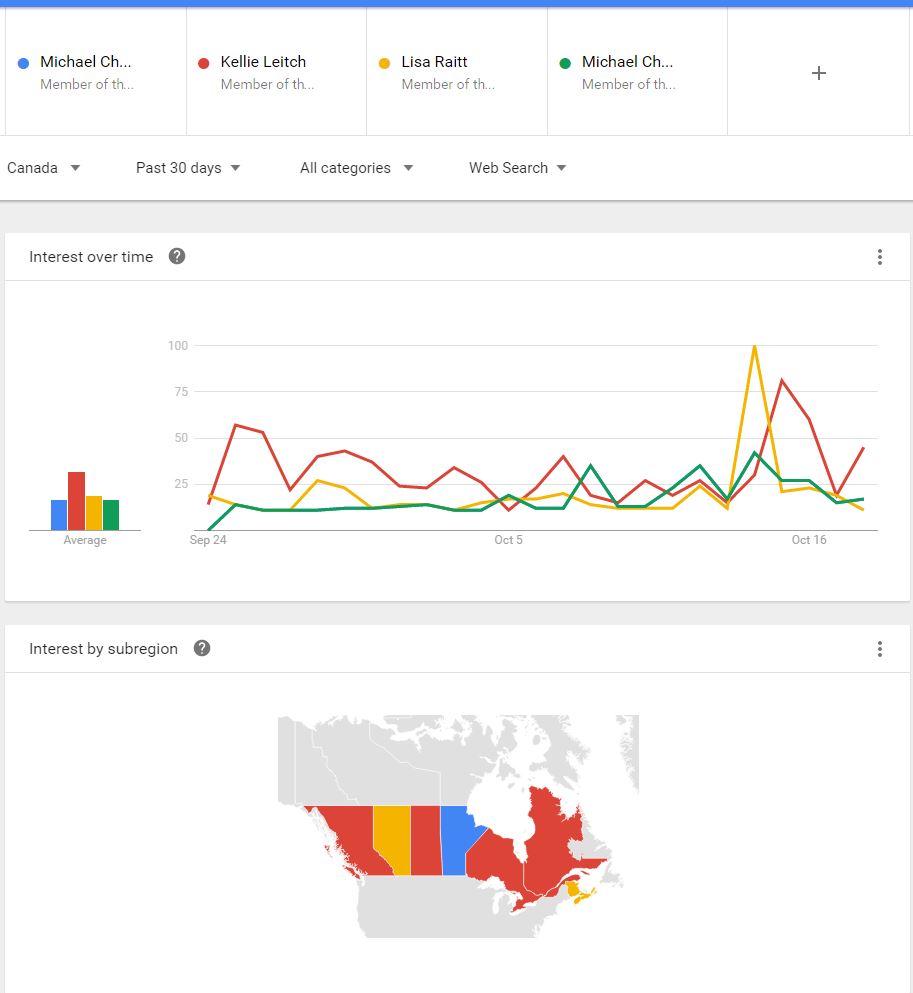
Look at the internet interest of the candidates for the past 90 days in Canada (in chunks of 5 as per above list):

For Michael Chong, Maxime Bernier, Kellie Leith, Deepak Obrhai, Andrew Scheer:
Kellie Leitch dominates interest overall but Maxime Bernier dominates in Quebec.


For Brad Trost, Steven Blaney, Erin O'Toole, Dan Lindsay, Chris Alexander:
Brad Trost dominates overall but Steven Blaney dominates interest in Quebec.


For Rick Peterson, Pierre Lemieux, Andrew Saxton, Adrienne Snow, and Lisa Raitt:
Lisa Raitt dominates overall with Pierre Lemieux grabbing more attention in Quebec.


What does this all mean for leadership candidates?


  1. If you want to grab attention, it may only last a couple days, so you need to keep the momentum going.  And in our now Twitter-dominated social media politics, you need to be relentless in your frequency.
  2. Start with your base and build from there.  It's no surprise there's competition in Quebec to attract disaffected soft Bloc supporters and their harsher stances on divisive issues.  Steven Blaney declared his candidacy and has come out wanting to ban the Niqab.
  3. Get on TV.  People need to see and hear you.


All that said, I tire of this Twitteresque/140 character attention sound bite crap and prefer discussing policies that actually affect our families, i.e. economy, taxes, jobs, health care, and education.  Being that health care and education are provincial responsibility (supposed to be), economics, jobs, trade, and justice are what I think most Canadians care about federally, not the endless divisive debates on what people wear or national unity.  Just look at the U.S. Presidential Election. It's sad how it has played out. I don't want Canada to have crappy campaigns like that where issues and ideas are subservient to crash statements that divide.  The U.S. wasn't this divided since the Civil Rights Movement and Civil War.

With that, my advice to all the candidates is to talk economy and taxes and don't waiver from breaking down and presenting what your plan would do in cost savings to average families.  Should you be bold about it?  Absolutely.  Why not?!  Let the naysayers take the debate to you.

Frontrunners

For me, the only candidate doing that right now is Maxime Bernier.  If he can maintain momentum and build beyond Quebec, he has a shot at winning.

I see the eventual front-runners to be:

Michael Chong -- who I think has the most growth potential and ability to syphon off disaffected liberals

Maxime Bernier -- he'll get the base of libertarians for sure, if he hasn't already, but growth potential is limited unless he can convince liberals that libertarian and liberal are supposed to be the same thing. Unfortunately, his English speaking ability may turn off harder Western folks who'll need some selling on that his policies line-up

Kellie Leitch -- because she's been controversial and is doing well in fundraising. Can she build her base beyond that controversy?

Lisa Raitt -- she could win it. She's moderate, relentless, smart, but her French will need work.